
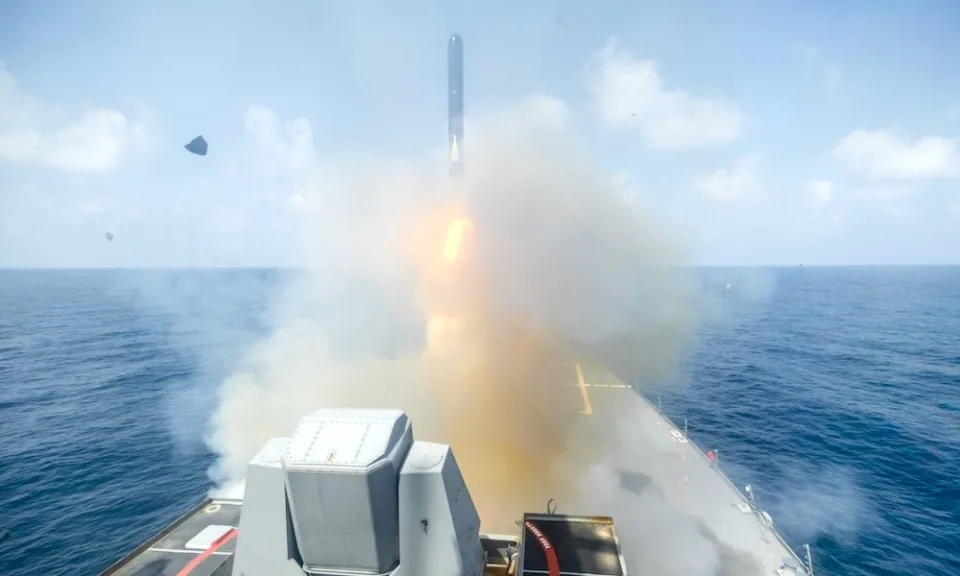
Security conditions in the Strait of Hormuz have deteriorated after the United States and Iran resumed exchanging fire, adding to concerns over mines, missile activity and a series of attacks on merchant vessels.
Iran’s Islamic Revolutionary Guard Corps said on Monday that an unidentified tanker struck two naval mines in the southern part of the strait. According to the IRGC, the vessel caught fire and came to a complete stop. No information was provided about the ship, its crew or cargo, and the reported incident has not been independently confirmed.
Context: Strait of Hormuz Intelligence File · Strait of Hormuz shipping guide · Strait of Hormuz
Tehran alleged that the tanker had been using an “illegal” route and warned ships to follow its navigation rules in Hormuz. Maritime security sources have also reported IRGC small craft approaching vessels to identify them and directing selected ships to abandon their transits. Iran has circulated a list of 46 vessels that it says violated its new navigation regime.
Operational context
The mine claim follows differing assessments of conditions around the internationally recognised traffic separation scheme. US Central Command said last week that mine-clearance operations had left the scheme free of sea mines. The Joint Maritime Information Center has taken a more cautious position, warning that drifting or uncharted mines could still threaten shipping and that designated mine-danger areas remain active.
The latest military escalation began on Sunday when US forces struck two Iranian launchers on Larak Island, which overlooks shipping lanes at the Gulf entrance. Washington said IRGC personnel had been preparing rockets carrying sea mines and characterised the strike as limited action against an imminent threat to shipping. It was the first known US strike inside Iran since late July.
Iran subsequently launched missile and drone attacks against US bases in Jordan. Iranian reports also referred to ballistic missile launches from several locations and anti-ship cruise missiles fired towards Hormuz, increasing the potential exposure of commercial vessels operating in the area.
The confrontation follows several attacks on tanker shipping. An unidentified inbound tanker was hit by an unknown projectile late on Saturday about 12 nautical miles north of Khasab, Oman. No casualties or pollution were reported. It was the third tanker struck in Hormuz in less than a week.
The Kuwaiti products tanker Al Salam II was hit on August 25, suffering a hole above the waterline and a small fire. A day earlier, the Liberian-flagged aframax Metro Venetian was disabled after an engine-room fire following another strike.
Normal shipping conditions remain disrupted six months into the conflict. The International Maritime Organization estimates that as many as 400 ships carrying approximately 6,000 seafarers remain unable to leave the Gulf safely.